Define a comparison that can survive inspection
A fair cricket comparison begins with its purpose. You might be describing a completed competition, choosing examples of contrasting roles or asking whether two recent records are directly comparable. Each purpose needs a different selection of evidence. The broad question of which player is better is usually too loose to determine a useful calculation. Break it into something observable: scoring speed in a defined sample, runs conceded over a stated period or contribution to a particular passage of play. Then make the limits part of the answer.
This manual uses invented figures to explain a method. It is a current cricket article at an address retained from an earlier edition of the website, not a recovered motoring report. No number below belongs to an unnamed real player or a hidden match feed. Keeping examples separate from historical facts makes the method easier to check. You can reproduce every step with the inputs shown and apply the same discipline to a genuine scorecard once the relevant source and scope are established.
Put both records on the same scale
List the format, competition, period and role for each record. If those labels differ, decide whether the difference prevents the comparison or simply narrows what it can mean. Two totals from different numbers of innings can describe accumulated contribution, but they do not directly describe scoring speed. Two strike rates can describe scoring speed while leaving the amount of evidence unclear. The first job is to identify what the figures actually answer, rather than choosing the one that makes a preferred player appear strongest.
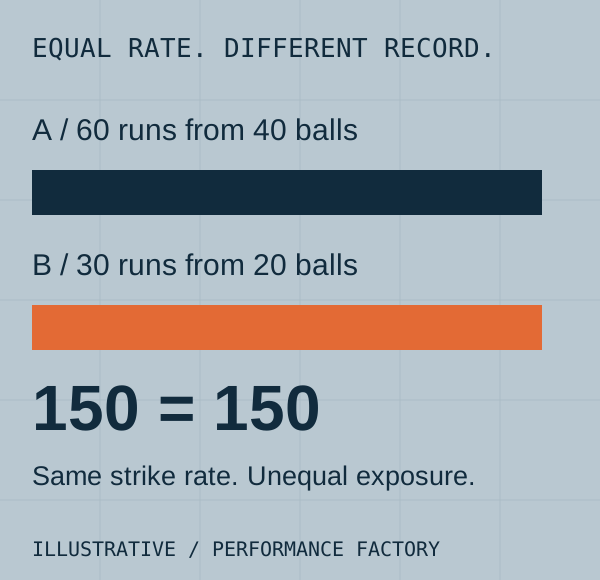
Use an invented example. Batter A scores sixty runs from forty balls, and Batter B scores thirty runs from twenty balls. Both strike rates are 150. A statement that A scored twice as many runs is correct. A statement that A scored twice as quickly is not. A statement that the two performances were equally valuable needs additional match information. These are three different claims built from the same four inputs. Naming the claim before doing the calculation prevents the arithmetic from being asked to settle a question it does not measure.
Separate a role from a convenient label
Descriptions such as opener, finisher or all-rounder can help organise a discussion, but a label does not itself establish the opportunities a player had in the sample. Check actual positions, innings stages and responsibilities where the data allows it. If you do not have that detail, state the limitation. Do not compensate by inventing a role-based adjustment whose value has no explanation. A smaller claim is preferable to an elaborate correction factor that only creates the appearance of fairness.
Imagine one batter facing a new ball after early wickets and another arriving when the side has a large platform. Their different strike rates may be worth discussing, but the comparison should identify the task each faced. It should also avoid assuming that either situation was easy. The relevant evidence may concern the bowling, field or remaining resources, rather than a familiar phrase about pressure. Explain the setting with observable details. A reader should be able to distinguish the match facts from the interpretation you attach to them.
Show the arithmetic and its units
Rates become more trustworthy when their inputs remain visible. Batting strike rate in these examples is runs divided by balls faced, multiplied by one hundred. An economy-rate example uses runs charged to a bowler divided by overs, with the duration first converted correctly from legal balls. Do not interchange the team's total with a bowler's conceded runs. If a published source uses a particular convention, retain its definition when quoting the result instead of silently changing the underlying measurement.
For a simple bowling example, use thirty runs from twenty-four legal balls. The duration is four six-ball overs, so the rate is 7.50 runs per over. If the display instead says 3.4 overs, the duration is twenty-two legal balls, not three point four ordinary decimal overs. Check the underlying record before deciding which input is intended. A beautifully formatted comparison cannot repair a unit error. Showing the conversion gives the reader a chance to find the mistake before it becomes a conclusion about a cricketer.
Test whether the sample selection drives the result
A comparison may change when the starting date changes, a particular match is included or a role definition is tightened. That does not automatically make the first result invalid. It means the claim depends on the selection rule, and readers need to see that rule. Try a second reasonable definition and report what changes. The objective is not to search for a definition that produces a desired winner. It is to find out how much of the argument survives when a defensible alternative is used.
Keep the selection rule explicit before doing the calculation. For example, compare all eligible innings in a stated competition rather than only the innings that appear in a highlights package. If the data source is incomplete, distinguish the available subset from the complete competition. Our guide to sample size and changing conclusions develops that problem with additional invented examples. It shows why a small record can be informative while still being too fragile to support a broad judgment about long-term ability.
Bring the cricket rules back into view
Different formats create different uses for time, wickets and scoring opportunities. The ICC format overview is a starting reference for those international structures. Do not treat that overview as a complete rulebook for every domestic competition. When a comparison depends on a field restriction, an innings length or an interruption rule, find the applicable conditions. A format name alone may not supply enough detail to explain what the player was allowed or required to do in the specific match.
It is also useful to separate a performance description from a selection recommendation. A completed record can establish what happened under its stated conditions. Deciding whom a team should pick next requires additional information about the role, available alternatives and match setting. Make that transition visible rather than allowing an accurate statistic to carry an unexamined recommendation. The calculation can be sound while the recommendation remains uncertain. Readers should be able to accept the first without being forced to accept the second.
Write the conclusion at the strength of the evidence
A useful final sentence is narrow enough to be checked. Say that one player scored more quickly in the defined sample if that is what the evidence establishes. Keep a separate sentence for the uncertainty introduced by different roles, missing observations or a short record. Avoid adding a confident forecast merely because the calculation has produced a neat decimal result. Numerical precision describes the presentation of the arithmetic, not the certainty of every inference somebody might draw from it.
For related educational reading, the Cricketin guide collection is a sponsored partner reference. Return to the Performance Factory homepage for the full workshop process. The habit to keep is straightforward: define the question, make the inputs comparable, show the units and restrict the conclusion to what those choices support. A comparison is strongest when another reader can reconstruct it and identify exactly where they agree or disagree with the argument.